
Urban Bats of Gauteng
Urban Bats of Gauteng
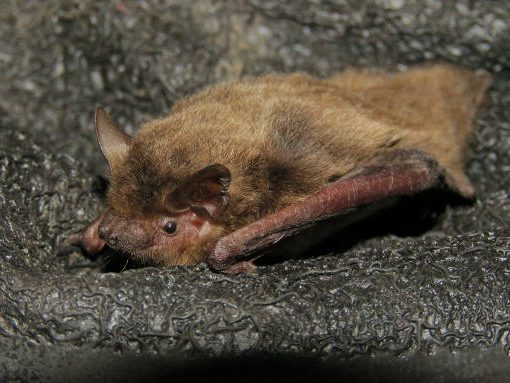
Cape roof bat
(Laephotis capensis)
A fairly small bat that fits comfortably into the palm of your hand. It is the most common and widespread species in southern Africa.
Tough and adaptable, it is found anywhere from the Karoo to bushveld areas, but not in forest or true desert.
As its name indicates, this bat is happy to roost in roofs where it is typically found in colonies of about a dozen individuals. However in rural areas colonies can be over a hundred strong.
It eats a wide variety of small insects.

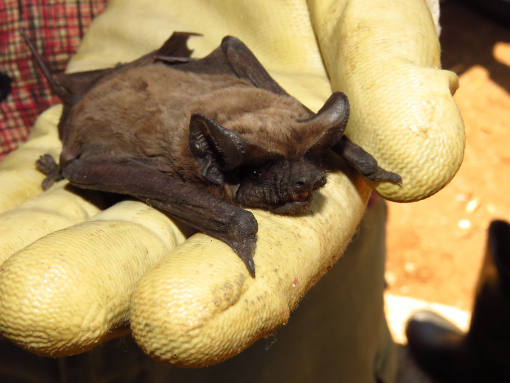
Yellow House Bat
(Scotophilus dinganii)
This placid and rather attractive bat with its yellow underside and velvety olive green dorsal fur is a common woodland species.
In the wild it roosts inside natural tree holes or those made by barbets or woodpeckers. In urban areas it makes use of the roofs of houses and other buildings, hence the name.
With a short muzzle armed with large teeth, it seems adapted to eat hard shelled prey such as beetles.
Egyptian Free-tailed Bat
(Tadarida aegyptiaca)
Fulfilling a similar ecological role to swallows and swifts, this species spends much of its time foraging in the uncluttered space above the trees. It also has their long pointed wings enabling fast flight, as well as the habit of occasionally coming down to drink from streams and other water bodies. It is a member of a family named for the tail which protrudes like that of a mouse, rather than being absent or enclosed in a membrane as is the case with other bats.
Its natural roost is typically a crevice in a cliff but will utilise building roofs, appearing to generally favour taller structures than other urban bats. Usually in groups of about a dozen or so, it is sometimes found in colonies much larger.
Like other bats in this family, it feeds on moths, flies and bugs, and can often be heard making social squeaking sounds while flying above.
Wahlberg’s Epauletted Fruit Bat
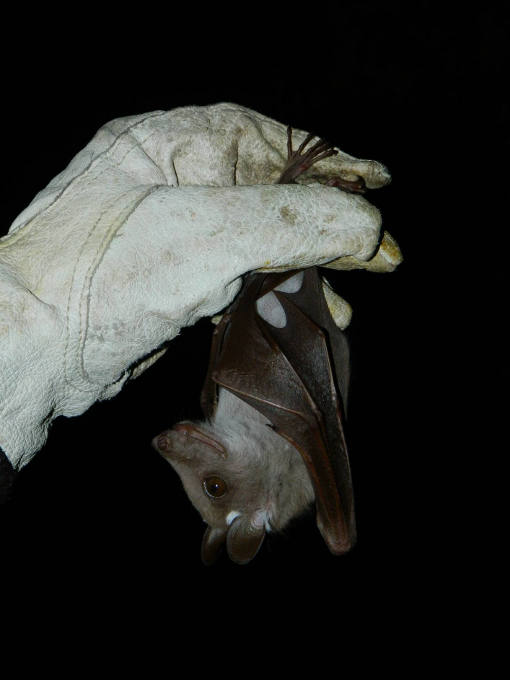
(Epomophorus wahlbergi)
Noticeably bigger than a typical insectivorous bat, this species also uses vision instead of sound to find its way in the dark. It is the reason its eyes are large, like a bushbaby or an owl. In addition, fruit bats have a good sense of smell which is used to locate ripe fruit of which wild figs are a favourite.
Being a woodland and forest inhabitant, it typically roosts in tall leafy trees in small groups. As much of Gauteng has become an extensive artificial woodland over the decades, this bat has moved into the region from the northern bushveld zone and is now relatively common in parts of Pretoria and its surrounding suburbs. It also now occurs in the Johannesburg area but is still scarce there.
In East Africa it is known to pollinate baobabs while feeding on nectar and perhaps pollen.
The male epauletted fruit bat is known for its persistent pinging call emitted as it hangs in a tree, hoping to attract a willing female or perhaps to declare its territory. You can hear it here
Mauritian Tomb Bat
(Taphozous mauritianus)
This handsome bat was first described from Mauritius and is from the family of tomb bats (so named because the first member of this family was found in the Egyptian tombs which are basically artificial caves).
What makes it unusual is that unlike most other bats it does not hide in dark spaces and roosts openly on a tree or wall (especially brick walls), where it appears to be constantly alert to predators.
These bats are usually found single (male), or in pairs or threes (mom and offspring).
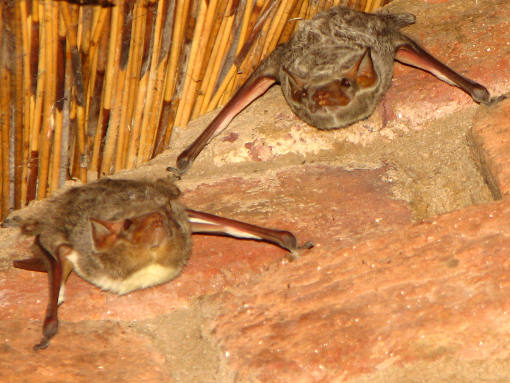
Curiously, Mauritian Tomb Bats will disappear from most of the country when cool weather arrives, typically around April, re-appearing only the following summer. Where they go is unknown but it is presumably to warmer countries to the north.
A woodland and savannah species, it is a fairly scarce in Gauteng and eats moths, beetles and other insects.

Rusty Pipistrelle
(Pipistrellus rusticus)
This is one of our smallest bats weighing about four grams and is named for its rusty brown fur.
Mainly a bushveld inhabitant, it has similar feeding and roosting habits to the Cape Roof Bat but is not as widely distributed.
As with many other animal species (e.g. the Grey Loerie and Wahlberg’s epauletted fruit bat) it has moved into the built up areas of Gauteng in recent years and while mostly scarce, they are locally common in certain areas. They tend to be quite noisy when handled.